
We simply cannot accept the results and now feel compelled to rectify this grievous generational lack of knowledge among the youth of Japan.
As far as legendary solo singer-songwriters of Japan go, perhaps no one is higher on the list than Masaharu Fukuyama (福山 雅治), nicknamed Masha, who turned 57 years old earlier this month. Known for his myriad of accolades in the entertainment industry including his prolific acting career, Fukuyama is THE celebrity of choice that the vast majority of middle-aged and older Japanese women are infatuated with (though his unrivaled popularity extends beyond gender as shown by his successful male-only and female-only concert runs in 2014). That’s why my brain simply couldn’t process what I was reading when I saw the headline of a recent research survey concluding that about one in five current high school students in Japan don’t even know who he is.
▼ “Whaddaya mean they don’t know who he is?!”

It’s like this–think of the most famous solo musician/singer in your country, and then try to imagine members of Gen Z drawing blank stares when you say their name. The headline was in fact so shocking–and downright disturbing–to me that I promptly messaged some Japanese friends who were born in the Showa period (1926-1989) or early years of the Heisei period (1989-2019). Their reactions matched my incredulity:
“I think it’s ridiculous.”
“I mean, how can that be possible???”
“My mom and aunt will die of shock when they hear the news.”
And yet, that’s exactly what Japanese marketing website Wakaimono Research concluded after distributing a survey last month to 343 current high school students–both male and female-identifying–in Japan. The initial question the research team posed was as follows:
Do you listen to Masaharu Fukuyama’s music?
● Yes, I listen to him–59.5 percent
● No, I don’t listen to him–40.5 percent
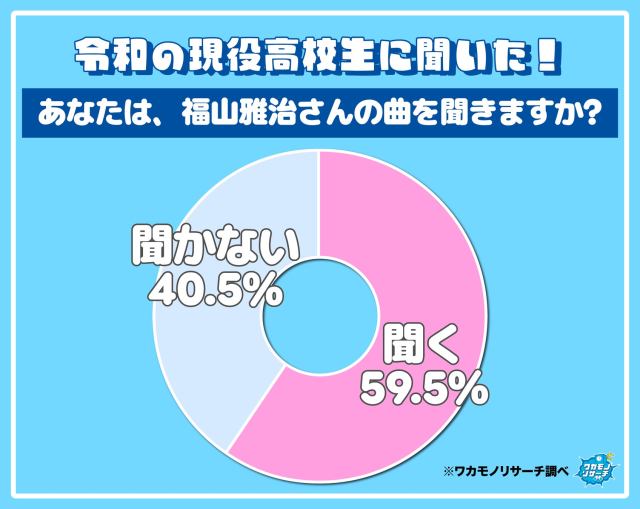
Based on the comments of the “No, I don’t listen to him” camp that indicated a lack of any recognition of Fukuyama, the research team was able to calculate that 19 percent–or about one in five–of all survey respondents didn’t even know who he is.
For further context–we’re talking about the same Fukuyama who, in September 2015, inadvertently created whole new entries in the Japanese lexicon for “Fukuyama Shock” and “Masha Loss” when he announced his marriage after enjoying a long life of bachelorhood up until then. News outlets across the country reported that many single women left work early because they were so in shock that they couldn’t focus on anything, subsequently drowning their sorrows by drinking or impulse buying expensive things like new apartments. Current high school students were likely in preschool when this news broke, so they probably weren’t even aware of the unique phenomenon as it was unfolding.
▼ We’re not sure which is more devastating–reliving the emotions that came with the news of Fukuyama’s marriage, or realizing when exactly today’s high school students were born…

OK, so by coming to terms with that last point everything starts to make sense, even if it doesn’t make me me feel any better.
In fact, among those survey respondents who noted that they listen to Fukuyama’s music, many of them noted that they became familiar with his music because their parents often play his songs (especially while driving in the car). Fukuyama’s melodies and arrangements–even those of his most recent works–are certainly reminiscent of times past and are a far cry from the catchy idol tunes and K-pop that today’s youth tend to gravitate to.
Nevertheless, Wakaimono Research was determined to dig a bit deeper, and so it uncovered which of Fukuyama’s songs are most popular among the current high school students that are familiar with him. While some of his biggest overall hits such as “Sakurazaka” and “Hello” made the list, it’s a bit surprising that neither of them clinched the number-one spot. The results are summarized below.
What are your favorite Masaharu Fukuyama songs?
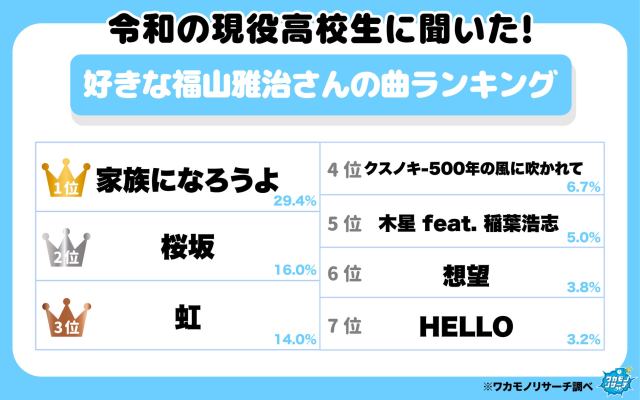
7. “Hello” (1995)–3.2 percent
“Hello” is the oldest song on this list, serving as Fukuyama’s 10th single. Its cumulative CD sales of about 1.87 million made it his second biggest hit after “Sakurazaka.”
6. “Sobo” / “Longing” (2023)–3.8 percent
“Sobo” was a digital single released in 2023 which served as the theme song to the time-traveling live-action film Ano Hana ga Saku Oka de, Kimi to Mata Deaetara (English title: Till We Meet Again on the Lily Hill) of the same year.
5. “Mokusei” feat. Koshi Inaba / “Jupiter” feat. Koshi Inaba (2025)–5 percent
The newest song on this list, “Mokusei” was released as a digital single on Christmas Eve of last year as a special collaboration with Koshi Inaba, the vocalist of best-selling J-rock duo B’z. The two also performed the song on last year’s Kohaku Uta Gassen, a longstanding singing competition show held annually on New Year’s Eve. It was the theme song of the film The Last Man -First Love-, also released on Christmas Eve.
4. “Kusunoki ~ Gohyakunen no Kaze ni Fukarete” / “Camphor Trees ~ Blown by 500 Years of Wind” (2025)–6.7 percent
Released last summer as a digital single, this song is a rearranged version of his 2014 single “Kusunoki.” As the child of survivors of the 1945 bombing of Nagasaki, Fukuyama donated the funds from this song to help preserve the city’s camphor trees that also survived the nuclear blast.
3. “Niji” / “Rainbow” (2003)–14 percent
“Niji” is definitely one of Fukuyama’s most popular works, first released as part of a triple A-side single and used as the theme song of the hit TV drama Water Boys and its sequel.
2. “Sakurazaka” / “Cherry Blossom Slope” (2000)–16 percent
Anyone of a slightly older demographic would likely choose “Sakurazaka” as Fukuyama’s representative work, having sold about 2.3 million CDs at the time of its release, making it his best-selling single. Keep an ear out for it if you’re ever walking around Japan during springtime.
1. “Kazoku ni Narou yo” / “Let’s Become Family” (2011)–29.4 percent
Gen Z likely got to know this song after it was featured in a commercial for wedding magazine Zexy and was sung as the White Team’s final song on 2020’s Kohaku Uta Gassen.
In summary, while I still can’t quite accept the fact that a growing chunk of Japan’s population isn’t acquainted with one of its biggest stars, I CAN turn my disbelief into action and do something about it. If you have any contact with the youth of Japan, we humbly ask that you also help in spreading Fukuyama Awareness. Perhaps it’s time to start preemptively educating the children about other Heisei-period legends of the Japanese music scene as well.
Reference: PR Times
Top image: Pakutaso
Insert images: Pakutaso (1, 2)
● Want to hear about SoraNews24’s latest articles as soon as they’re published? Follow us on Facebook and Twitter!