
Sometimes you need to tell your bosses you need a break, but you need someone else to be the one to tell them.
Job-quitting services have been a thing in Japan for several years now. Essentially you pay a fee to an agency, and they’ll dispatch a representative to inform your employer that you’re quitting and handle any paperwork or other procedures that need to be done so that you can sever the professional relationship with no loose ends.
Now, though, there appears to be rising demand for proxies for people who don’t necessarily want to call it quits at work, but who need an extended break, giving rise to a leave-of-absence-request service.
Saitama Prefecture legal office Kawagoe Mizuho Law has been offering a leave-of-absence-request proxy service, called kyushoku daiko in Japanese, since about 10 years ago, and it’s seen an uptick in requests since the start of this business year, working with an average of around 40 clients per month.
To clarify, customers aren’t using the kyushoku daiko service to ask for a day off so that they can catch a baseball game or go to a concert by their favorite idol singer (that’s a subject to discuss with your insurance provider). Kawagoe Mizuho’s clients are seeking extended absences from their workplace, many times due to health issues or familial responsibilities that need tending to. In the case of health concerns, those can include psychological stress and other mental health concerns, in which cases the client may not feel up to navigating the procedural requirements to make the leave of absence request, and is worried about a potential skeptical or even antagonistic response from their employer further damaging their mental condition.
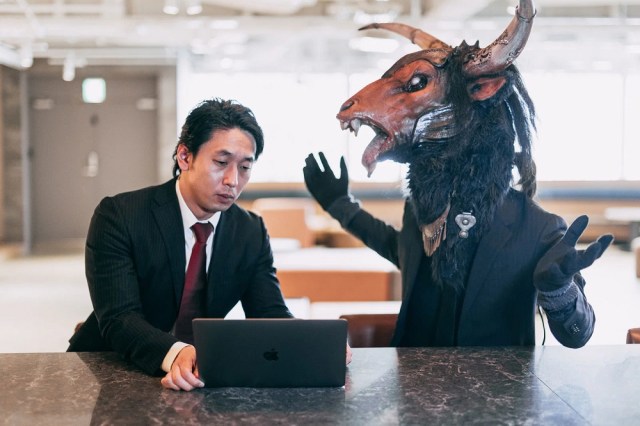
▼ “All right, explain it to me one more time, Tanaka-kun. WHY do you think you deserve a leave of absence?”
“Because you’re literally the devil.”
In many ways, the agent’s role in kyushoku daiko overlaps with the one for a job-quitting proxy. The agent formally conveys the client’s intent to the employer, and the news being delivered by an intermediary hopefully leads to a calmer dialogue and, in the case that the employer does get hot under the collar, the agent being subject to any outbursts instead of the client. However, leave-of-absence proxy work has a few aspects that can make it more complex than job-quitting proxying.
Once an employee tells their employer they’re quitting, the boss can’t veto that and legally compel them to come in to the office. In some cases, job-quitting proxy work might require the agent to sort out issues such as securing any remaining salary or retirement allowances their client is owed, but in general, job-quitting proxy services are a unilateral declaration that the client is leaving the company.
Requesting a leave of absence, though, is often a bilateral negotiation. Whereas there are universal laws requiring employers to accept resignations from workers, there’re no blanket legal rules governing leaves of absence. Eligibility, timing requirements, length limits, and procedures for reintegrating into the workplace vary from organization to organization. As such, leave-of-absence-request proxy projects involve more back-and-forth communication with the employer, something an exhausted or stressed worker may wish for an agent to do on their behalf, especially if the source of their stress is the boss they’d have to be negotiating with.
But if you not only need a leave of absence, but find your job so unpleasant that you need someone else even to handle the request for you, why not just quit? Because, as Kawagoe Mizuho points, out, many of its kyushoku daiko clients (who typically pay 55,000 yen [US$340] for the service) want to keep working at their current organizations, just not necessarily under the same conditions. When they do go back to work, the majority of Kawagoe Mizuho’s clients are reintegrating with a different position within the organization, and the change of direct manager, immediate coworkers, specific responsibilities, and overall workload can prove to be a much more suitable fit than what they had before.
And while there might be a temptation to assume that kyushoku daiko users are all fresh-faced twenty-somethings whose digital native lifestyles have left them unprepared for face-to-face interaction in the adult world, Kawagoe Mizuho says that in addition to recent college grads, their clients have included middle management-level employees in their 50s and even civil servants, showing that there’s a broad range of people who could use a little help finding the work style that works best for them.
Source: Sankei Shimbun via Yahoo! Japan News via Hachima Kiko, Kawagoe Mizuho Law
Top image: Pakutaso
Insert image: Pakutaso
● Want to hear about SoraNews24’s latest articles as soon as they’re published? Follow us on Facebook and Twitter!


