
What’s behind Japan’s continuing slide down the list?
Every year EF Education First, a Switzerland-based company that provides language learning services and assistance in countries around the world, prepares its English Proficiency Index (or EF EPI) report, based on scores from its EF Standard English Test. In the newest edition of the report, released late last month, Japan has fallen to its lowest ranking ever since the EF EPI was introduced in 2011.
The index was calculated using the results from 2.2 million test takers aged 18 and up who took the test in 2024, representing 123 countries in which English isn’t the primary language (countries had to have at least 400 test takers to be included in the rankings). Japan finished in a tie with Afghanistan at 96th in the overall rankings, down four places from the previous year and its 11th year in a row to slide down the list. Japan didn’t score well regionally, either, finishing 18th out of the 25 Asian nations included in the report, behind mainland China and South Korea (86th and 48th overall, respectively).
▼ Education First EPI results map for 2025
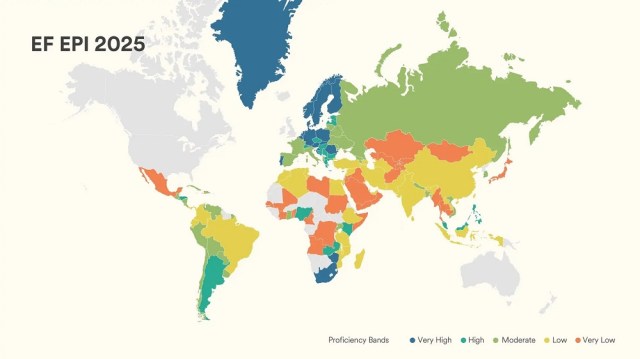
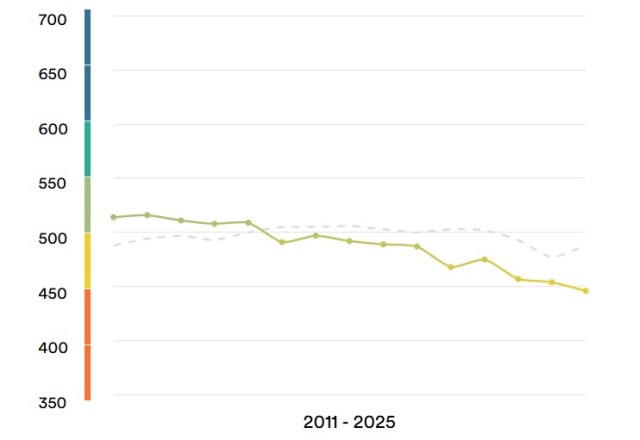
Japan didn’t just slip in relative terms, either, as the country’s average proficiency index score, 446, was eight points less than the year prior and 42 below the latest report’s global average of 488. Looking at Japan’s numerical score since the first iteration of the index in 2011, the country has only had a few modest upticks, and its score has never risen for two years in a row.
▼ Japan’s EF EPI score (green/yellow line) versus the global average (dotted line)
When the data is broken down by skill set, the scores show a wide gap in Japanese English learners’ ability to understand the language versus being capable of expressing themselves in it, along with much greater comfort in written communication than in verbal.
Average scores by skill set for Japanese test takers
● Reading: 454
● Listening: 437
● Writing: 394
● Speaking: 393
This fits rather neatly with the long-established narrative about the problems of English education in Japan, that lessons and teaching methods are too focused on rote memorization and adherence to strict, narrow grammatical formats, with insufficient efforts to teach practical, flexible communication strategies, real-world usage styles, and cultivate confidence in self-expression. To be sure, those are all valid criticisms that not just teachers in the classroom, but also administrators who’re in positions to set institutional education policies, should be trying to address.
▼ “Yes, I know that is a pen. Can we learn something new now?”

At the same time, we also have to consider the question of whether Japan’s declining scores are in part a result of depleted motivation. An important thing to remember is that the EF English Proficiency Index is calculated from scores of test-takers 18 and older, so while there are some teens in their last year of high school who are part of the examined demographic, the vast majority of the scores are coming from people who are either working adults or in non-compulsory stages of higher education. They’re not being forced to study English, and in recent years multiple factors have almost certainly put a damper on the enthusiasm of English learners in Japan. Japan is currently grappling with its highest inflation rate in generations, with most workers seeing little to no increase in their wages as prices for everything, including necessities like groceries and utilities, continue to rise. The yen is also at the lowest value, versus foreign currencies, that it has been for several decades.
Many Japanese people are finding themselves with less and less money left over after paying their bills, and what money they do have left over isn’t going to go nearly as far outside Japan. As a result, traveling abroad, let alone relocating overseas to go to school or look for work, has become a bigger financial challenge, one outside the budget of no small number of people. Since Japanese people can get along just fine speaking only Japanese while they’re in Japan, removing the reward of using English to enrich their overseas experiences (since they can’t afford to go overseas) gives them less reason to push through personal problem areas they encounter when studying the language, and when that happens, lower test scores aren’t a shock.
▼ Beefing up your English vocabulary becomes less of a priority when you’re worried about the price of beef at the supermarket.

One could perhaps argue that the other side of the weak yen-coin, the increased number of foreign tourists coming to Japan, is giving Japanese people more opportunities to use English without going abroad themselves, and so should be a substitute study-motivating factor. However, that’s dampened by the growing image of places in Japan that attract large numbers of foreign tourists have become too crowded and expensive for locals to enjoy, and so some have begun avoiding those areas.
Further highlighting the relationship between benefit potential, motivation, and acquired proficiency, Kanto, the region of east Japan that includes Tokyo, had the highest Education First English Proficiency Index score within Japan, at 478, while the western, and largely rural, Chugoku region of west Japan had the lowest, 436. By city, Tokyo had Japan’s third highest score, 480, with nearby Yokohama in second place with 483. Kawasaki, Tokyo’s immediate neighbor to the south, had Japan’s highest city score at 489, one point higher than the global average. With Tokyo and the surrounding area representing the country’s highest concentration of schools, companies, and other organizations with an international outlook, it does seem like proximity to chances to use English in meaningful ways plays a part in cultivating and attracting more proficient learners, so hopefully more such opportunities will become available once again.
Source: EF Education First (1, 2, 3, 4), PR Times, Tokyo Shimbun
Top image: Pakutaso
Insert images: PR Times, EF Education First, Pakutaso (1, 2)
● Want to hear about SoraNews24’s latest articles as soon as they’re published? Follow us on Facebook and Twitter!


